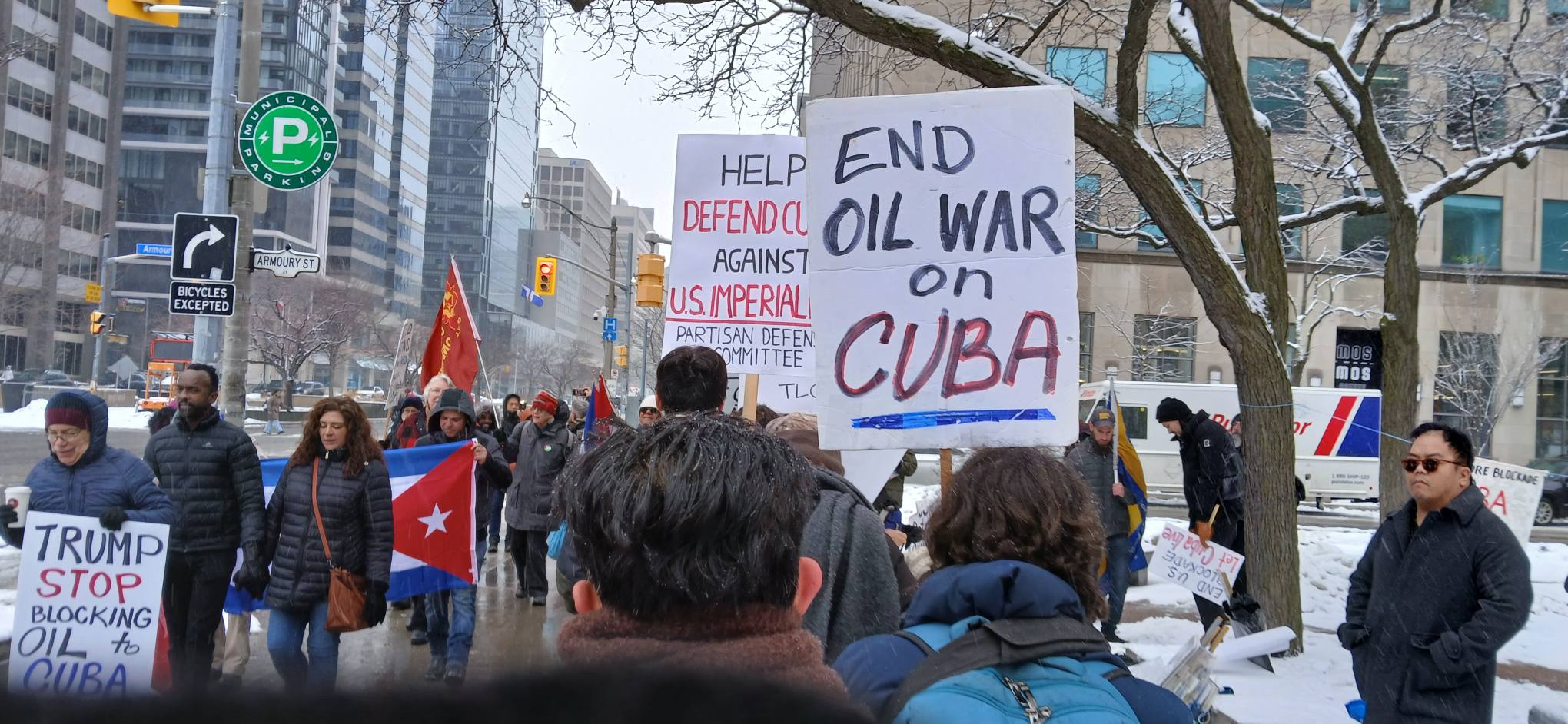
(Photos from Cuba solidarity rally in Toronto in front of U.S. Consulate, February 2026)
In the face of the U.S. fuel blockade, Canada must work with other countries to support Cuba
The people of Cuba face a dire humanitarian crisis that has worsened in the wake of U.S. President Donald Trump’s threats to impose tariffs on any nation that exports oil to Cuba.
On February 25, the government of Canada announced a further $8-million contribution to relief efforts, but much more is needed – especially fuel – to ensure aid can reach people in need. Numerous non-governmental organizations including churches and trade unions are doing what they can to help.
Call on the Canadian government to:
- support all necessary actions to prevent an avoidable, human-made crisis, including a humanitarian carve-out for oil and aid free of U.S. interference.
- reaffirm Canada’s commitment to an independent foreign policy with Cuba that respects self-determination.
- increase food and medical aid to Cuba beyond current levels and make diplomatic efforts with other countries to end the U.S. blockade on oil and ease the impact of ongoing U.S. sanctions.
- work with the United Nations, Mexico, Colombia and other countries to get fuel to Cuba.
Background
On January 29 this year, President Trump threatened Mexico and other countries with new tariffs if they continued to ship oil to Cuba. The threat was condemned by a group of United Nations human rights experts on February 12. A New York Times analysis on February 20 showed that the Trump administration has established an effective blockade of the country and is pushing its people toward a humanitarian crisis.
Other U.S. measures not only restrict U.S. citizens and businesses from providing support to the Cuban people but also interfere with the delivery of humanitarian aid by other countries because banks limit transactions. As a result, suppliers face risks of U.S. retaliation, and the shipping of freight becomes more complicated and costly.
What’s Happening in Cuba
It’s a time of exceptional need. Cuban partner organizations and recent visitors say conditions in Cuba today are far worse than in the early 1990s when the implosion of the Soviet Union led to a massive deterioration in living standards. The COVID pandemic shuttered the tourism industry, a main source of revenue used to acquire food, medicine and fuel from abroad. Cuba has also suffered a series of hurricanes, droughts and floods, leading to lost crops and food shortages. Energy shortages limit public transit, ambulance service and garbage collection.
Try to imagine what living conditions are like for the average Cuban
Until recently Cuba depended on Venezuela for its oil. After the removal of Venezuelan President Nicolás Maduro and his spouse by U.S. forces on January 3, some oil came from Mexico – until the Trump administration threatened new tariffs and put the upcoming CUSMA trade negotiations at risk. The U.S. government initiated an oil blockade, forbidding the delivery of fuel – except for small quantities it would allow to reach privately-owned small and medium businesses. Now the Financial Times estimates that there is fuel for just three weeks.
Given the lack of fuel, life in Cuba is extremely difficult. Workers cannot go to work as there is virtually no public transportation. Students cannot go to classes and online access is limited. There are daily blackouts throughout the country – usually 8-10 hours every day. Factories are closed. Getting water is increasingly difficult, since it often needs to be pumped. There is difficulty in getting food to market because of transportation problems. There has not been steady garbage pickup for weeks. As a result, mosquito-borne disease is increasing. Healthcare is suffering badly – and ambulance service has been reduced. Cuban media reported that as of mid-February 32,000 pregnant women were unable to have ultrasound scans because hospital generators lacked fuel. Access to x-rays, CT scans and radiation therapy have been cut back drastically, and only emergency cases are being dealt with.
The people of Cuba face a massive humanitarian crisis. On February 26, international NGOs working in Cuba over many years issued an urgent humanitarian appeal to the international community to “fulfil their obligations under international law, protect the civilian population, and ensure full access to essential services and humanitarian assistance.”
To date, many governments have been reluctant to engage in meaningful negotiations with the United States to end the blockade, instead prioritizing the mobilization of humanitarian aid. This approach risks normalizing a situation that could – and should – be prevented.
Fortunately, asking Canada to increase support to Cuba is consistent with Canada's history of strong relations with Cuba and maintenance of an independent foreign policy:
- Canadian non-governmental organizations, faith-based groups, trade unions and civil society groups have worked continuously with Cuban partners to maintain strong people to people connections and to provide humanitarian and development assistance.
- Canadian laws seek to protect Canadian corporations from of U.S. measures that try to prevent foreign countries from engaging in international trade with Cuba.
- Canada and Mexico were the only two countries in the Western hemisphere in the 1960s to preserve diplomatic relations with Cuba.
- Cuba is Canada’s top market in the Caribbean/Central American sub-region and is Canada’s largest merchandise export market in that region.
To counter the impact of U.S. measures, Canada should take these actions:
- Reject U.S. measures that block fuel from reaching Cuba and support a humanitarian carve-out so that relief can be delivered free of U.S. interference.
- Work with the United Nations, Mexico, Colombia and other countries to get fuel to Cuba.
- Continue to increase efforts to provide immediate food, medicines and medical supplies and ongoing development assistance to Cuba.
- Engage in diplomatic efforts with the United Nations, the United States, and with other nations to end U.S. measures that isolate and harm the Cuban people.
- Strengthen Canada’s commitment to an independent foreign policy with Cuba based on dialogue, constructive engagement and respect for self-determination rather than punitive measures such as sanctions that only hurt the Cuban people.